
In the Garden of the Mind, the Tragedy Began
A Psychological Perspective on Adam and Eve | RALD Healing — Ancient Word Institute
Decoding the human mind through biblical stories
The story of Adam and Eve disobedience suffering reveals how the first human choice changed the human mind, relationships, and connection with God.
Adam and Eve Disobedience Suffering: Why Did the Fall Bring Pain?
Let’s begin—not with the fruit, the serpent, or the consequences.
Let’s begin with the garden.
Adam and Eve were placed in a space of beauty and completeness. Everything they needed was already there. Their identity was clear. Their connection with God was direct. There was no shame, no fear, no confusion.
Nothing was missing.
And yet—something was.
They had everything, but they lacked gratitude.
And then, a single conversation changed everything.
It wasn’t dramatic. There was no disaster, no visible crisis.
Just a question:
“Did God really say…?”
That’s where the story begins.
And if we’re honest—that’s where many of our stories begin too.
The Trigger: How Doubt Quietly Enters the Mind
The serpent didn’t force anything. There was no threat, no pressure.
Just a question—carefully framed.
“Did God really say you must not eat from any tree in the garden?”
Notice the shift.
God had said they could eat from every tree except one.
But the question reframed it as any tree—as if God was withholding, limiting, unfair.
This is how distortion works. Subtle. Quiet. Psychological.
Before Eve ever touched the fruit, something had already shifted within her.
Her focus moved:
- from what she had → to what she didn’t have
- from trust → to doubt
- from abundance → to lack
And that shift changed everything.
Sound familiar?
This is exactly how comparison works today.
Through social media. Through expectations. Through constant exposure to other people’s lives.
You scroll for a few minutes—and suddenly:
- what you have feels small
- what you are feels insufficient
- what once felt enough… no longer does
It’s not that your life changed.
Your perspective did.
The trigger was never the fruit.
It was the shift in how things were seen.
The Decision: When Reason Overrides Trust
Eve looked at the fruit.
And she saw something reasonable:
- it looked good
- it seemed beneficial
- it appeared to offer wisdom
This wasn’t an impulsive act.
She thought it through.
And that’s important—because not every wrong decision feels reckless.
Sometimes, it feels logical.
Sometimes we convince ourselves into choices we already know are misaligned.
Adam, standing right there, said nothing.
And then he followed.
Two people. One moment. A decision that couldn’t be undone.
The Internal Process: What Changed Within
This is where the real shift happens—not outside, but inside.
The moment they ate, something broke internally.
“Their eyes were opened”—but not in the way they expected.
They didn’t gain clarity.
They became self-conscious.
For the first time, they became aware of themselves in a way that felt uncomfortable.
They felt exposed.
They felt vulnerable.
They felt… ashamed.
This is what shame does
Shame is not just about what you did.
It’s the feeling that something is wrong with you.
It attacks identity.
It whispers:
- You are not enough
- You are the problem
- You need to hide
And that’s exactly what they did.
The First Human Reaction: Hide and Cover
They covered themselves with fig leaves.
Think about that.
The very first human response to inner brokenness was:
- to hide
- to cover
- to control how they were seen
And we’re still doing the same thing today.
Understanding Adam and Eve disobedience suffering helps us see why humanity struggles with guilt, shame, and separation from God.
Different methods. Same pattern.
Then God came into the garden.
And they hid.
Not because God didn’t know where they were.
But because they no longer knew how to stand in His presence.
The Breakdown Cycle
When God asked, “Where are you?”
It wasn’t about location—it was about awareness.
But instead of honesty, the cycle unfolded:
- Disobedience → I chose my will over God’s
- Shame → I am exposed
- Fear → I need to protect myself
- Hiding → I will avoid the truth
- Blame → It’s not my fault
Adam blamed Eve.
Eve blamed the serpent.
No one took ownership.
And this cycle still repeats itself—every day, in different forms.

The Turning Point: Two Possible Paths
What’s often missed is this:
God didn’t come to destroy them.
He came asking questions.
He gave them space.
He gave them a chance to be honest.
The opportunity for restoration was already there.
But they chose differently.
They chose:
- blame over responsibility
- avoidance over honesty
And that choice prolonged their struggle.
Two paths still exist today
The resistance path:
- Protect the ego
- Blame others
- Avoid accountability
- Stay stuck
The surrender path:
- Be honest
- Take ownership
- Stop hiding
- Trust that honesty leads to restoration
They chose resistance.
But even then—grace remained.
God covered them.
He didn’t abandon them.
He walked with them, even into the consequences.
The Journey Back
The exile wasn’t just punishment.
It was the beginning of a return.
A long journey back home—not to a place, but to the self.
The Modern Mirror — Adam and Eve’s Story in Us
You don’t need a garden to live this story.
It shows up in everyday moments:
- When what you have suddenly feels like it’s not enough
- When you justify a decision you know isn’t right
- When your first instinct is to hide, deflect, or blame
That’s the same pattern—playing out again.
This cycle is deeply ingrained.
And it lives in all of us.
But there is a way out
The shift begins the moment you choose honesty.
Not with others first—but with yourself.
And with God.
Ownership is not weakness.
It is the doorway out.
A Moment of Reflection
Before you move on, sit with this:
Where in your life are you hiding—covering yourself instead of facing what’s really there?
A Lesson to Carry With You
The next time you feel shame, fear, or the urge to blame—pause.
Recognize it for what it is:
a deeply ingrained pattern running on autopilot.
Then ask yourself:
Am I choosing to hide… or to be honest?
That one decision can change everything.
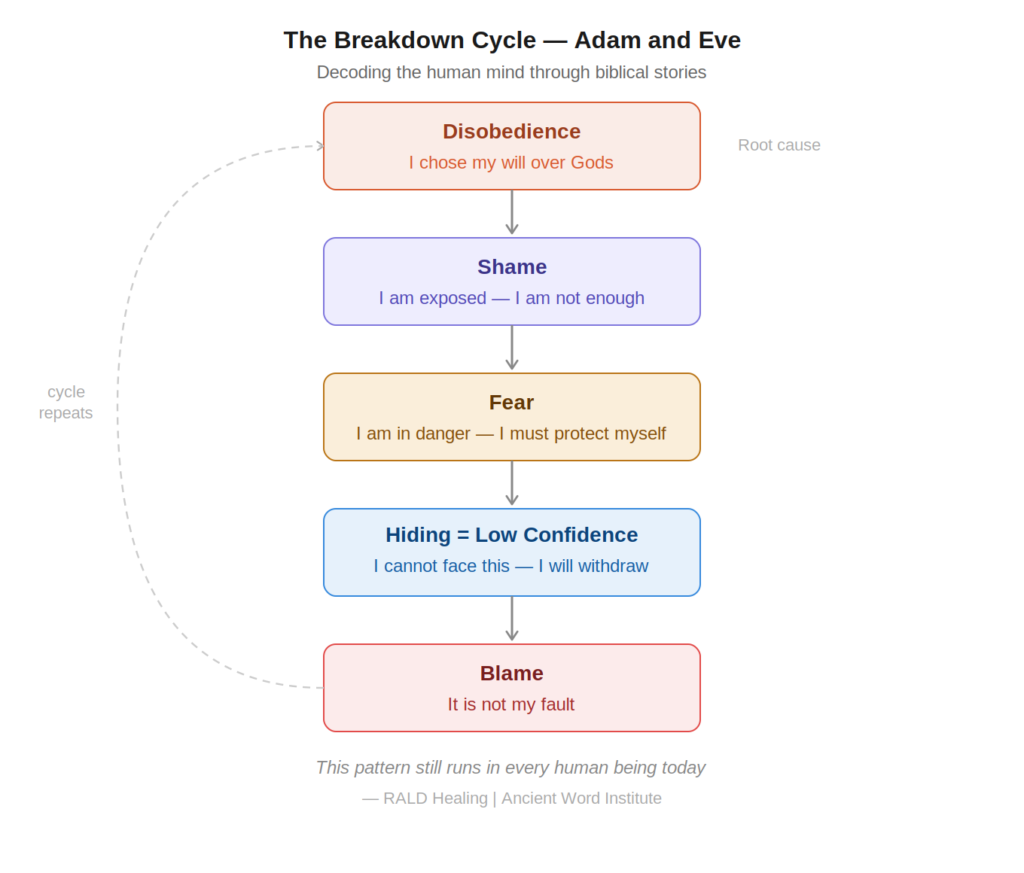
The message behind Adam and Eve disobedience suffering reminds us that healing begins when we face truth instead of hiding from it.
A Prayer for Whoever Needs It
Heavenly Father,
I have been hiding—from You, from others, and even from myself.
I have covered my shame with blame, and my fear with control.
Today, I choose to stop running.
I come before You as I am—open, vulnerable, and in need.
Give me the courage to choose honesty over performance,
and surrender over self-protection.
I trust that You already see me,
and that You have not left me.
Restore what this cycle has broken.
You alone know what is truly missing in my life—
what You have intended for me.
Whatever is lacking, whatever pulls me into dissatisfaction
and takes away my peace, I place it in Your hands.
Amen.
If you want to go deeper into renewing the mind, read our article on the mindset of a disciple.
RALD Healing | Ancient Word Institute
www.raldheling.com